Market Fluctuates Near Highs as Tech Boost Fades, Regional Banks Surge, and Trade Deficit Widens

On Wednesday, both the S&P 500 and Nasdaq Composite closed lower, hovering near their highest closing levels since August 2022. The S&P 500 slipped by 0.38%, settling at 4,267.52, while the Nasdaq Composite declined by 1.29%, ending at 13,104.89. However, the Dow Jones Industrial Average stood out among the major averages, adding 91.74 points or 0.27% and closing at 33,665.02.

Energy emerged as the best-performing sector in the S&P 500, experiencing a rise of approximately 2.6%. Notably, the SPDR S&P Oil & Gas Exploration & Production ETF (XOP) and First Trust Natural Gas ETF (FCG) both gained over 3%. Regional banks also saw continued growth, with the SPDR S&P Regional Banking ETF (KRE) rising more than 3%. PacWest Bancorp’s shares surged by 14.4%, while Zions Bancorporation added 4.5%.

Despite the recent market rally driven by the promise of artificial intelligence and a 7% increase in the S&P 500 over the past three months, Bob Doll, Chief Investment Officer at Crossmark Global Investments, cautioned about the future impact of the Federal Reserve’s interest rate hikes. Doll pointed to ongoing concerns such as leading economic indicators declining for 13 consecutive months, an inverted yield curve, and liquidity issues. He advised caution and urged investors not to get carried away by the current rally.

Meanwhile, the U.S. trade deficit continued to rise in April, although it came in slightly below economists’ expectations. This deficit could potentially lead to lower GDP growth in the second quarter.

All sectors' performance as tech boost fades, regional banks surge, and trade deficit widens.

Data by Bloomberg

On Wednesday, the overall performance of sectors in the market showed a slight decline, with all sectors experiencing a decrease of 0.38%. However, some sectors managed to outperform the market. Energy was the best-performing sector, with a positive price change of 2.65%. Real estate and utilities also had a good day, with gains of 1.75% and 1.70% respectively. Industrials and materials followed suit with increases of 1.59% and 1.18%.

Financials had a modest gain of 0.33%. On the other hand, several sectors faced declines. Consumer staples and healthcare experienced small decreases of 0.33% and 0.41% respectively. Consumer discretionary had a larger decline of 0.91%. The worst performers were information technology and communication services, both with significant decreases of 1.62% and 1.87% respectively.

Major Pair Movement

The US Dollar Index (DXY) is facing downward pressure around 104.00 as the market balances hawkish Federal Reserve expectations with concerns about US economic growth. Despite the strong performance of US Treasury bond yields and the dollar’s safe-haven status, the index fails to reflect these positive factors.

At the same time, the EUR/USD pair is trading within a week-long Pennant formation near 1.0700, with bullish and bearish forces in contention due to fears of an economic slowdown, higher interest rates, and weaker Eurozone data.

In other currency developments, the GBP/USD pair experiences a slight upward movement but remains significantly below the previous day’s weekly peak around the key level of 1.2500. The pair finds support from the subdued performance of the US Dollar.

Similarly, AUD/USD remains low at approximately 0.6650 after retreating from a one-month high, as concerns about the Reserve Bank of Australia’s hawkish stance and worries about economic growth weigh on the Australian dollar.

Additionally, USD/CAD initially dropped to a low of 1.3318 following an unexpected interest rate hike by the Bank of Canada, marking the lowest level since May 8. However, the pair later rebounded to around 1.3400, erasing its losses, due to the overall strength of the US dollar supported by higher US yields.

Picks of the Day Analysis

EUR/USD (4 Hours)

EUR/USD Holds Steady Ahead of ECB Meeting and US Economic Indicators

The EUR/USD pair showed a mixed performance as it initially dipped close to weekly lows near 1.0645, surged to 1.0739 – its highest level since Friday – and then retraced back to the 1.0700 range. The pair remained range-bound, eagerly awaiting new catalysts and events scheduled for the following week.

The upcoming European Central Bank (ECB) meeting, where a rate hike is expected, will be a crucial event with new forecasts, shaping market expectations for July. Germany’s reported industrial production increase of 0.3% MoM in April fell short of expectations. On Thursday, a fresh estimate of Q1 Euro area GDP and employment change data will be released.

Meanwhile, the US dollar gained momentum after the Bank of Canada’s rate hike and was further supported by surging US bond yields, with the 10-year yield reaching the highest level since May 29. The focus shifts to upcoming events, including the Federal Reserve’s decision on the Fed Fund rate, as well as potential actions from the Reserve Bank of Australia and the impact of US employment data, particularly the crucial Consumer Price Index report on Tuesday and the weekly jobless claims report on Thursday.
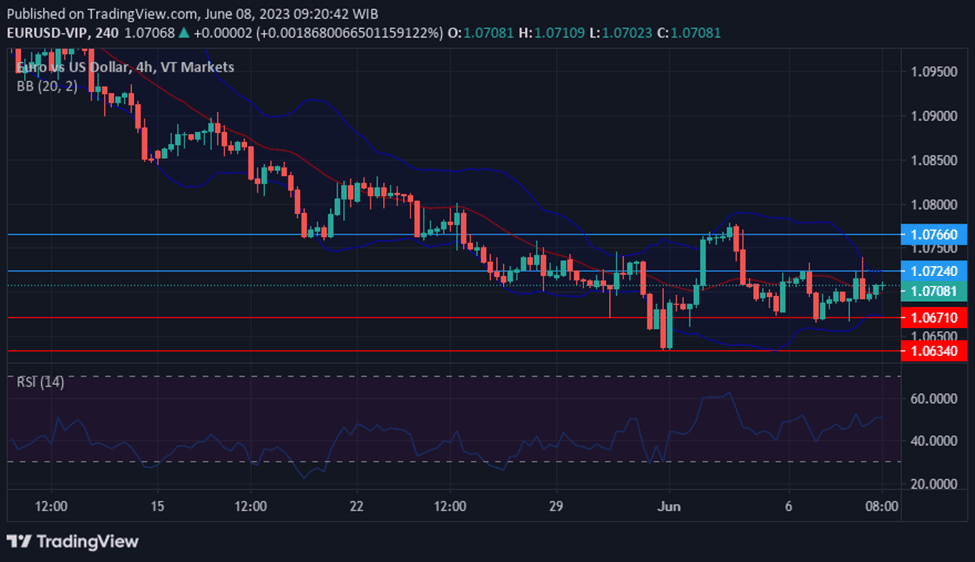
EURUSD movement as tech boost fades, regional banks surge, and trade deficit widens.

Chart EURUSD by TradingView

According to technical analysis, the EUR/USD pair moved in flat on Wednesday as we can see that the upper and lower bands is getting narrower. Currently, the EUR/USD is running just above the middle band, with the potential for it to move higher and try to push the upper band of the Bollinger Bands. The Relative Strength Index (RSI) is currently at 50, indicating that the EUR/USD is in a neutral trend.

Resistance: 1.0724, 1.0766

Support: 1.0671, 1.0634

XAU/USD (4 Hours)

Gold (XAU/USD) Retreats as US Dollar Regains Strength Amid Speculation of Fed Rate Hike

Gold (XAU/USD) experienced a decline after reaching a peak of $1,970.15 per troy ounce, nearing the $1,940 level. The initial weakness of the US Dollar was reversed during the US session, as rising US government bond yields provided support. The speculation surrounding the US Federal Reserve’s potential decision to raise interest rates by 25 basis points next week favoured the USD, despite still high odds for no change. The Bank of Canada’s surprise rate hike and the Reserve Bank of Australia’s recent move cast doubt on the expected end of the tightening cycle in the US. The mixed trading of US stock indexes reflected the uncertainty surrounding the Fed’s next steps, while the 10-year Treasury note and 2-year note yields rose by 8 and 6 basis points, respectively.
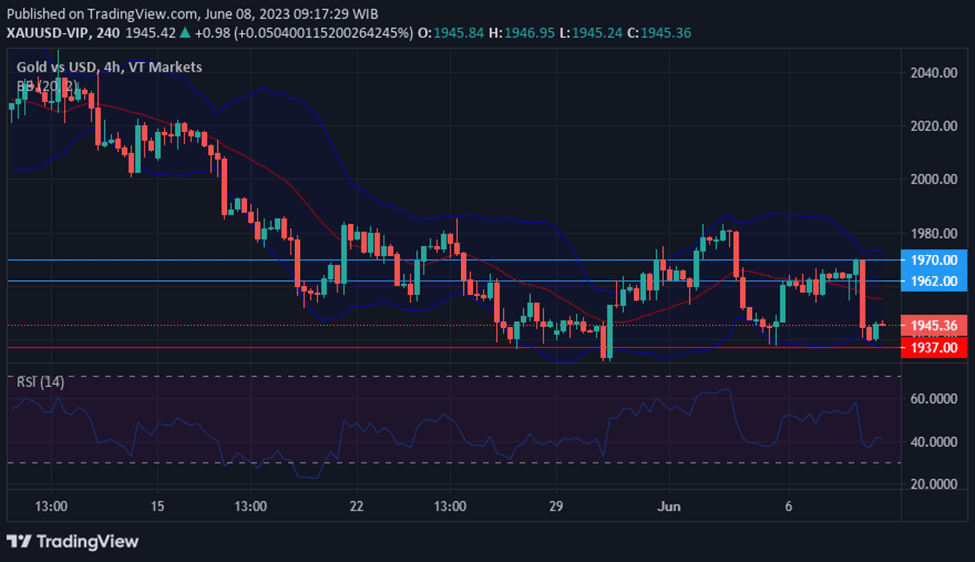
XAUUSD movement as as tech boost fades, regional banks surge, and trade deficit widens.

Chart XAUUSD by TradingView

According to technical analysis, the XAU/USD pair is moving higher in the early session on Wednesday but then drop to break our support level in the US session and reach the lower band of the Bollinger Bands. There is a possibility that the XAU/USD will move back higher for today and try to reach the middle band of the Bollinger Bands. Currently, the Relative Strength Index (RSI) is at 41, suggesting that the XAU/USD is in a slight bearish tone.

Resistance: $1,962, $1,970

Support: $1,937, $1,927

Economic Data

CurrencyDataTime (GMT + 8)Forecast
USDUnemployment Claims20:30236K

S&P 500 Hits Highest Close of 2023, Coinbase Faces SEC Lawsuit

On Tuesday, the S&P 500 reached its highest close since the beginning of 2023, reflecting a recent rally that propelled the index to its strongest level in nine months. The broad-market index added 0.24% to finish at 4,283.85, marking its highest close since August 2022. Similarly, the Nasdaq Composite also achieved a closing high for 2023, rising 0.36% to end at 13,276.42. Meanwhile, the Dow Jones Industrial Average experienced a slight uptick of 0.03%, or 10.42 points, closing at 33,573.28, hindered by notable losses in Merck and UnitedHealth.

In other market news, Coinbase faced a significant setback as it plummeted over 12% following a lawsuit filed by the Securities and Exchange Commission (SEC) against the cryptocurrency company. The SEC accused Coinbase of operating as an unregistered broker and exchange. On a positive note, Bitcoin saw an increase of more than 6% according to CoinMetrics. Additionally, Apple shares declined by 0.2% the day after the highly anticipated unveiling of their virtual reality headset and new software at the annual Worldwide Developer Conference, despite hitting an all-time high in the previous trading session.

All sectors performance after the recent market movement.

Data by Bloomberg

On Tuesday, the overall market experienced a positive price change of 0.24%. Among the sectors, Financials showed the highest increase with 1.33%, followed by Consumer Discretionary at 0.99%. Energy and Real Estate sectors also saw gains, with increases of 0.69% and 0.66% respectively. Materials and Industrials sectors had relatively smaller gains of 0.65% and 0.60% respectively. Communication Services showed a modest increase of 0.49%. On the other hand, Utilities experienced a slight decline of -0.07%. Information Technology and Consumer Staples also showed negative price changes, with decreases of -0.12% and -0.47% respectively. Health Care sector had the largest decrease of -0.88% on Tuesday.

Major Pair Movement

On Tuesday, the US dollar (USD) strengthened due to a lack of significant risk events and a limited news calendar. The US Dollar index had a volatile trading session within a narrow range. The dollar received support from weakness in the euro (EURUSD), while positive growth forecasts for the US by Goldman Sachs and the World Bank further boosted the greenback.

Among the G10 currencies, the euro (EUR) underperformed, causing EURUSD to reach lows of 1.0668 before finding some support at a Fibonacci level. This decline followed a disappointing report on German industrial orders and a consumer survey conducted by the European Central Bank (ECB), which revealed a significant decrease in inflation expectations. Adding to the bearish sentiment were dovish comments from ECB member Knot, known for his hawkish stance, who stated that “the worst of inflation is behind us.” More ECB statements are scheduled for Wednesday, which could reinforce this cautious outlook.

The Australian dollar (AUD) stood out as the top performer among the G10 currencies after the Reserve Bank of Australia (RBA) surprised the market with a 25-basis point rate hike, bringing rates to 4.10%. The RBA’s hawkish statement, indicating the possibility of further rate increases, propelled AUDUSD to a high of 0.6685, just shy of the 200-day moving average at 0.6692. The Australian dollar held most of its gains after the announcement throughout the session.

Picks of the Day Analysis

EUR/USD (4 Hours)

EUR/USD Drops Amid Cautious Markets as Focus Shifts to Central Bank Meetings

The EUR/USD experienced a decline while trading around the 1.0700 area, with attention turning to upcoming central bank meetings. The European Central Bank (ECB) is expected to raise interest rates by 25 basis points next week, followed by another potential hike in July. However, economic indicators, such as stagnant retail sales in the Eurozone and a decline in German factory orders, reflect consumer caution. The US Dollar saw modest gains as market participants remained wary ahead of a crucial week, considering a bleak global outlook and the anticipation of higher interest rates. The Federal Reserve’s upcoming FOMC meeting is awaited with caution, as analysts closely monitor the May Consumer Price Index as a determining factor.

EURUSD dropped as focus shifts to Central Bank Meetings.

Chart EURUSD by TradingView

According to technical analysis, the EUR/USD pair moved lower on Tuesday, trying to reach the lower band of the Bollinger Bands and moved flat before closing the day. Currently, the EUR/USD is running just below the middle band, with the potential for it to move lower to reach the lower band of the Bollinger Bands. The Relative Strength Index (RSI) is currently at 45, indicating that the EUR/USD is in a neutral trend.

Resistance: 1.0724, 1.0766

Support: 1.0671, 1.0634

XAU/USD (4 Hours)

Gold (XAU/USD) Under Pressure as Markets Await Central Bank Decisions and Inflation Data

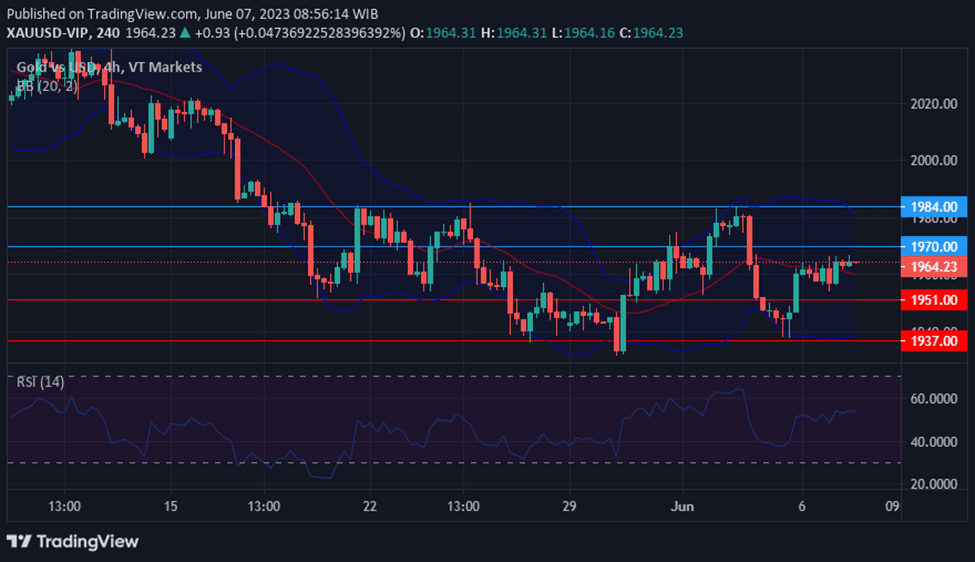
Gold (XAU/USD) facing slight downward pressure, hovering around $1,960, as financial markets adopt a cautious stance due to discouraging macroeconomic data and upcoming major announcements. Weighing on market sentiment are softer-than-expected figures, alongside anticipation of monetary policy decisions by the US Federal Reserve and the European Central Bank. While the Fed is expected to maintain its current stance, the ECB is likely to implement another rate hike. Additionally, the US will release an update on inflation before the Fed’s decision, with the May Consumer Price Index anticipated to rise by 4.2% YoY. Despite the Fed’s tightening measures, the labour market remains tight, and wage inflation remains a concern. Economic growth has slowed due to monetary tightening, and central banks are striving to strike a delicate balance between maintaining economic activity and curbing inflation. The recent bank crisis in March has prompted policymakers to adopt a cautious approach, but if inflation remains high and the labour market remains tight, the US central bank may resume raising interest rates, leading to uncertainty in the financial markets.

XAUUSD faces slight decline as the market await Central Bank decisions and inflation data

Chart XAUUSD by TradingView

According to technical analysis, the XAU/USD pair is moving higher on Tuesday, reaching above the middle band of the Bollinger Bands. There is a possibility that the XAU/USD will continue to move higher and try to reach the upper band of the Bollinger Bands. Currently, the Relative Strength Index (RSI) is at 54, suggesting that the XAU/USD is in a neutral but slightly bullish trend.

Resistance: $1,970, $1,984

Support: $1,951, $1,937

Economic Data

CurrencyDataTime (GMT + 8)Forecast
AUDGross Domestic Product q/q09:300.3%
CADBOC Rate Statement22:00
CADOvernight Rate22:004.50%

Stocks Slip as Market Consolidates Gains, Eyes Fed’s Inflation Target

On Monday, the S&P 500 ended the day lower, wiping out earlier gains that had brought the index to its highest level in nine months. The S&P 500 lost 0.2%, closing at 4,273.79, while the Nasdaq Composite dipped 0.09% to 13,229.43, and the Dow Jones Industrial Average dropped 0.59% to 33,562.86. Apple’s stock declined by around 0.8% after unveiling its virtual reality headset and software updates at its developers’ conference. Intel also saw a 4.6% drop due to Apple’s announcement of a new chip, and Nvidia pulled back on valuation concerns. JPMorgan Chase and Goldman Sachs faced struggles following news of potential increased capital requirements for large banks. The market’s recent consolidation of gains came after a broad-based rally on Friday, buoyed by positive economic indicators and the passage of the debt ceiling bill.

While investors are hopeful about the economy and the recent market rally, concerns linger about the narrow focus on a few tech stocks and the potential for an intermediate-term correction if market breadth does not improve. The Federal Reserve’s target for managing inflation is a key factor that could impact market movements going forward. Investors are eager to see if the central bank will revise its 2% inflation target. Despite these uncertainties, some analysts remain optimistic that the market can catch up and close the gap in other sectors as long as the economy continues to show resilience and avoid recessionary signs.

Data by Bloomberg

On Monday, the overall market experienced a slight decline of 0.20%. Among the different sectors, Communication Services saw a positive gain of 0.58%, followed by Utilities with a 0.45% increase. Health Care and Consumer Discretionary sectors also performed well, gaining 0.38% and 0.35% respectively. On the other hand, Materials experienced a slight decline of 0.10%. Consumer Staples, Real Estate, Information Technology, Financials, Energy, and Industrials all saw negative changes ranging from -0.35% to -0.71%.

Major Pair Movement

The US dollar weakened after the ISM services data revealed that a significant portion of the US economy was struggling to avoid contraction, with concerns about a potential recession. The decline in the ISM’s employment index, new orders, and prices paid contributed to the cautious market sentiment. This raised doubts about the possibility of a rate hike this month, supported by disinflationary data and indicators of a weaker labour market.

As a result, Treasury yields and the dollar reversed earlier gains, with expectations shifting towards a delay in rate increases. The euro-dollar exchange rate remained relatively unchanged despite the European Central Bank’s plans for future rate hikes. The British pound recovered slightly, while the US dollar against the Japanese yen experienced a decline. The market showed less willingness to pursue new Treasury yield and dollar highs, awaiting upcoming CPI data and Federal Reserve events.

In summary, the US dollar’s weakness reflected concerns about the struggling US economy and the potential delay in rate hikes by the Federal Reserve, leading to cautious market behaviour.

Picks of the Day Analysis

EUR/USD (4 Hours)

EUR/USD Rebounds as US Dollar Weakens on Disappointing Economic Data

The EUR/USD saw a rebound during the American session, driven by the broad-based weakness of the US dollar following the release of underwhelming US economic data. Federal Reserve rate expectations remain influential ahead of the upcoming June 13-14 meeting.

In contrast, the Euro experienced mixed performance due to lacklustre economic reports and European Central Bank President Christine Lagarde’s testimony. Lagarde hinted at potential rate hikes in the Euro area, while Eurozone data fell below expectations. Meanwhile, the US ISM Services PMI report further dampened the US dollar as it fell short of projections. Consequently, US Treasury bonds gained strength, impacting Wall Street and causing US yields to drop.

Chart EURUSD by TradingView

According to technical analysis, the EUR/USD pair is moving higher on Monday, reaching the middle band of the Bollinger Bands. Currently, the EUR/USD is trading just above the middle band, with the potential for it to move higher and reach the upper band of the Bollinger Bands. The Relative Strength Index (RSI) is currently at 49, indicating that the EUR/USD is in a neutral trend with a slightly bullish bias.

Resistance: 1.0766, 1.0824

Support: 1.0706, 1.0671

XAU/USD (4 Hours)

Gold (XAU/USD) Recovers as US Dollar Falters on Weak Data, Uncertainty Surrounds Fed’s Monetary Policy Decision

In the first half of the day, the US Dollar showed strength but later reversed course due to lacklustre American data. Amidst this, Gold (XAU/USD) rebounded from its intraday low and hovered near a recent high. The decline in the ISM Services PMI and modest Factory Orders growth put pressure on the USD, causing Treasury yields to fall. Market participants are grappling with uncertainty regarding the upcoming US Federal Reserve monetary policy decision, as inflation remains slow while the job market remains tight. As the decision approaches next week, financial markets await further communication from American policymakers.

The US Dollar started strong but reversed course due to weak US data, causing the XAU/USD to recover from a low and trade near a recent high. The decline in the ISM Services PMI and modest Factory Orders growth pressured the USD. US Treasury yields fell after initially rising post a solid Nonfarm Payrolls report. Uncertainty surrounds the upcoming US Federal Reserve decision, as inflation slows while the job market remains tight. Market participants anticipate the Fed to hold off on rate hikes in their June meeting but keep future hikes as a possibility. The Fed’s decision will be announced next week, keeping financial markets waiting for updates from American policymakers.

Chart XAUUSD by TradingView

According to technical analysis, the XAU/USD pair is moving higher on Monday, reaching the middle band of the Bollinger Bands. There is a possibility that the XAU/USD will continue to move higher and try to reach the upper band of the Bollinger Bands. Currently, the Relative Strength Index (RSI) is at 51, suggesting that the XAU/USD is in a neutral but slightly bullish trend.

Resistance: $1,970, $1,984

Support: $1,951, $1,937

Economic Data

CurrencyDataTime (GMT + 8)Forecast
AUDCash Rate12:303.85%
AUDRBA Rate Statement12:30

节假日可交易时间变更通知 – 2023年06月05日

尊敬的用户:

您好!

受到国际节假日影响,VT Markets 部分产品交易时间将有所调整,详情请查看如下:

注:”-” 符号表示正常交易時間。

以上时间为MT4/5服务器时间,其他产品交易时间不受影响,在极少数情况下,以上信息可能会因流通性供应商的调整而变化,具体请以MT4/5实际交易时间为准。

以上时间为系统时间(GMT+3)

如您有任何疑问,我们的团队将十分乐意为您解答。
请留言或发邮件至 [email protected] 或联系在线客服。

一日新增数千个交易账户 VT Markets“征战”拉美市场首战告捷

5月24日,一场拉美市场备受瞩目的金融盛会——墨西哥货币博览会(Money Expo Mexico)隆重启幕,VT Markets作为获邀参展的经纪商之一,在本次展会上带来了出众的产品和服务,迅速成为现场焦点之一,并获得了数千个新增交易账户。这是VT Markets自去年正式进军拉美地区后,账户数量真正意义上实现跨越式增长,是平台扎根拉美市场进程中迈出的可喜一步,更是集团打造全球业务版图的崭新注脚。

不鸣则已一鸣惊人,VT Markets缘何进军拉美市场不到一年时间,就已势如破竹?靠的是不变的多元化思维与灵活的本地化运营。

多元化思维的发挥与运用

金融交易是一个迭代革新的行业,产品、技术、服务都需要适应不断变化的发展浪潮,任何一个经纪商平台,想要在百花齐放的市场中脱颖而出,就必须保持敏锐嗅觉,寻找新的突破点,在这个过程中,多元化思维的运用将成为关键手段。

VT Markets的多元化始终以交易者为核心导向,为了满足交易者稳健、避险或高收益的多元需求,不断增加更多领先市场趋势的产品和指标工具,从而奠定了多元化经纪商的地位。

而开拓新兴市场不仅是VT Markets多元化发展的一环,也是平台全球布局的重要战略,它与品牌的愿景也是高度契合的,VT Markets希望可以把平台广受赞誉的产品、技术和服务推广到各个国家和地区,让众多交易者能够通过一次次卓越的交易体验,顺利实现财务目标。

而本次在墨西哥货币博览会上的成功,也彰显了VT Markets在拉美市场日渐增长的影响力。

新市场的大门已打开,接下来要考虑的是,要怎么做才能走得更稳更远?从全球化到本土化的转变至关重要。

从全球化到本土化的转变

VT Markets在将近10年的发展过程中已经形成一套高标准的交易服务体系,可适应全球不同市场,但无论是多么先进的体系,在进入一个全新市场时,都需要结合当地市场的格局、客群特色和偏好进行调整,在保持全球化标准的前提下,实行本土化服务、本土化活动、本土化营销,使当地交易者能够快速、畅行无阻的进入全球市场。

因地制宜,是扎根新市场的必经之路。

拉美地区作为关键战略市场之一,具有不可估量的潜力和价值,VT Markets对于该市场的发展充满期待,并做好充分准备迎接爆发式的业务增长,以期在新的金融格局出现时能够成为引领趋势,促进行业发展的“弄潮儿”。

下一步,VT Markets将以欧洲、亚洲和中东办事处为依托,持续向拉美地区等新兴市场推进,通过逐渐提升品牌影响力,巩固VT Markets作为全球领先的经纪商地位。

Week Ahead: Markets to Focus on US ISM Services PMI, and RBA and BOC Rate Statements

" "

In the week ahead, market participants will turn their attention to key economic events including the US ISM Services PMI, as well as rate statements from the Reserve Bank of Australia (RBA) and the Bank of Canada (BOC). As analysts make their predictions, all eyes will be on these releases to understand their potential impact on financial markets

Switzerland’s Consumer Price Index (5 June 2023)

Consumer prices in Switzerland stalled in April 2023, showing less growth than the 0.2% rise observed in March 2023.

For May 2023 data, which is set to be released on 5 June 2023, analysts expect a 0.1% increase.

US ISM Services PMI (5 June 2023)

The US ISM Services PMI increased to 51.9 in April 2023 from 51.2 in March 2023.

Data for May 2023 is scheduled for release on 5 June 2023, with analysts anticipating a higher figure of 52.1.

Reserve Bank of Australia Rate Statement (6 June 2023)

In a surprising move, the Reserve Bank of Australia raised its cash rate by 25bps to 3.85% in May 2023, after keeping it at 3.6% in April 2023. This marks the 11th time the bank has increased rates in the past year.

The next cash rate will be released on 6 June 2023, with analysts expecting the RBA to hold its interest rate at 3.85%.

Bank of Canada Rate Statement (7 June 2023)

In its April 2023 meeting, the Bank of Canada (BOC) kept the target for its overnight rate unchanged at 4.5% and stated that it would continue to monitor the latest economic data for future decisions on the policy rate.

The next rate statement will be released on 7 June 2023. Analysts anticipate that the BOC will keep its interest rate steady at 4.5%.

Canada Employment Change (9 June 2023)

Canada’s economy added 41,400 jobs in April 2023 due to increased part-time work, the first growth since October 2022. The unemployment rate stayed at 5% for the fifth month, near the record-low of 4.9%.

For May 2023 data, set to be released on 9 June 2023, analysts predict that job creation will dip to 40,000 and the unemployment rate will rise to 5.1%.

Stocks Rise as U.S. House Passes Debt Ceiling Bill, Earnings Reports Impact Market

Stocks experienced gains as the U.S. House of Representatives successfully passed a debt ceiling bill, reducing the risk of a default. Despite a 4.7% decline in Salesforce shares following their earnings report, the Dow Jones Industrial Average rose by 0.47%, closing at 33,061.57. The S&P 500 and Nasdaq Composite also reached their highest levels since August 2022, with gains of 0.99% and 1.28% respectively. With the debt ceiling issue resolved, investors now turn their attention to the upcoming Federal Reserve policy meeting and the potential impact of rising interest rates.

The bipartisan passage of the Fiscal Responsibility Act, by a vote of 314-117, brought relief to the market by removing a major negative catalyst. The Senate is expected to follow suit, ensuring the bill reaches President Biden’s desk. Analysts suggest that the equity market had already discounted the debt ceiling concerns, shifting focus to the possibility of future interest rate hikes. Meanwhile, positive economic data, including stronger-than-expected private payroll growth and lower-than-forecasted jobless claims, reinforced the market’s optimism about the economy’s recovery. Investors will closely monitor the Federal Reserve’s policy meeting for insights into the central bank’s stance on interest rates.

Data by Bloomberg

On Thursday, the stock market saw overall gains, with all sectors experiencing positive movement except for Consumer Staples and Utilities. The Information Technology sector led the way with a strong increase of 1.33%, followed closely by Industrials, Materials, and Energy, all of which saw gains above 1%. Consumer Discretionary and Communication Services also performed well, with increases of 1.22% and 1.15% respectively. Financials and Health Care sectors showed solid growth as well, with gains of 1.09% and 0.67% respectively. Real Estate had minimal movement, with a slight increase of 0.03%. However, the Consumer Staples sector experienced a slight decline of -0.09%, while Utilities saw a notable decrease of -0.78%.

Major Pair Movement

On Thursday, the U.S. dollar weakened as concerns over the Federal Reserve’s rate hike cycle grew, while optimism surrounding the debt ceiling eased and U.S. economic data indicated a cooling economy. The dollar’s decline was also influenced by positive news from Europe, including better-than-expected economic indicators and the European Central Bank’s potential interest rate hikes. Additionally, the ADP report exceeded expectations, but revisions to previous job data and other economic indicators revealed a slowdown in the U.S. economy.

Investors are closely watching Friday’s payrolls data to gauge the Federal Reserve’s future actions and the impact on the dollar. If the payrolls report continues to outperform expectations, it could lead to a more bearish outlook for the dollar. Currently, a June rate hike by the Fed is seen as unlikely, and the probability of a 25 basis point hike in July is uncertain, while rate cuts are priced in for later in the year.

Meanwhile, the euro strengthened by 0.7% against the dollar, reaching its highest level in six sessions, supported by rebounding yield spreads and oversold charts. Sterling and risk-sensitive currencies like the Australian dollar also gained ground. However, the yen experienced a 0.4% loss due to declining Treasury-JGB yields and a reversal of the overbought uptrend observed in May.

Picks of the Day Analysis

EUR/USD (4 Hours)

EUR/USD Surges as Dollar Weakens Amid Falling Fed Rate Hike Expectations

The EUR/USD experienced a significant rally on Thursday, propelled by a widespread decline in the US dollar as expectations for Federal Reserve rate hikes diminished ahead of the US employment report. Eurozone data confirmed a slowdown in inflation, providing relief for the European Central Bank (ECB) and reducing the need for further interest rate increases. The weakening dollar was driven by signals from Fed officials suggesting a pause in rate hikes and increasing market expectations of future rate cuts.

Additionally, improved market sentiment, supported by positive Chinese data, the resolution of the debt ceiling issue, and easing inflation data, contributed to the dollar’s decline. Focus now turns to the Nonfarm Payrolls report on Friday, which is expected to provide further insights into the US economic situation.

Chart EURUSD by TradingView

According to technical analysis, the EUR/USD pair is moving higher on Thursday, creating upward momentum towards the upper band of the Bollinger Bands. Currently, EUR/USD is trading near the upper band of the Bollinger Bands. We anticipate that the EUR/USD will experience a slight downward movement today and attempt to reach the middle band of the Bollinger Bands. The Relative Strength Index (RSI) is currently at 61, indicating that the EUR/USD has entered the overbought zone.

Resistance: 1.0766, 1.0824

Support: 1.0706, 1.0671

XAU/USD (4 Hours)

Gold (XAU/USD) Rises as US Dollar Weighed Down by Mixed Economic Signals

The US dollar experienced a turbulent day of fluctuations as investors digested news from the United States, resulting in significant selling pressure on the currency and pushing XAU/USD (gold) to trade around $1,980 per troy ounce. The initial optimism surrounding the suspension of the debt-limit ceiling was followed by a brief recovery in the dollar due to positive labor market indicators. However, a downward revision in Q1 Unit Labor Costs and a contraction in the May ISM Manufacturing PMI underscored the fragility of the US economy, weakening the dollar and creating an environment favorable for gold. These mixed economic signals have put the Federal Reserve in a challenging position, with pressure to maintain an aggressive monetary policy while inflation remains subdued.

Chart XAUUSD by TradingView

According to technical analysis, the XAU/USD pair is exhibiting upward movement on Thursday, approaching the upper band of the Bollinger Bands. There is a possibility that the XAU/USD will experience a minor downward correction and retrace towards the middle of the Bollinger Bands throughout the day. At present, the Relative Strength Index (RSI) is at 62, suggesting that the XAU/USD is currently in the overbought zone.

Resistance: $1,984, $2,004

Support: $1,963, $1,951

Economic Data

CurrencyDataTime (GMT + 8)Forecast
USDNon-Farm Employment Change20:30193K
USDUnemployment Rate20:303.5%
USDAverage Hourly Earnings20:300.3%

Stocks Fall as Debt Ceiling Debate Looms and May Trading Month Ends

Stocks declined on Wednesday as investors closely watched the federal debt ceiling debate in Washington. The Dow Jones Industrial Average dropped 0.41%, the S&P 500 dipped 0.61%, and the Nasdaq Composite slipped 0.63%. A debt ceiling deal between President Joe Biden and House Speaker Kevin McCarthy progressed to the House floor, with a vote expected later in the day. While analysts anticipate the deal to pass, concerns remain about potential adjustments and the need for more time to reach an official agreement. Investors are also focusing on the upcoming June Federal Reserve policy meeting.

The May trading month concluded with mixed performance. The Nasdaq Composite experienced a 5.8% increase, driven by gains in artificial intelligence-related stocks and technology companies. Despite a temporary loss in month-to-date gains during Wednesday’s market sell-off, the S&P 500 closed the month with a modest 0.3% gain. In contrast, the Dow Jones Industrial Average declined by almost 3.5% in May, primarily due to significant losses in several major companies, including Nike, Walt Disney, Walgreens, 3M, Chevron, and Dow, Inc. Investors are taking precautionary measures ahead of the debt ceiling vote, securing profits before potential market volatility.

Data by Bloomberg

On Wednesday, the stock market experienced a mixed performance across different sectors. The Utilities sector showed a gain of 0.96%, followed by Health Care with a positive movement of 0.85%. Real Estate also saw a modest increase of 0.66%, while Consumer Staples had a slight gain of 0.07%. However, there were declines in various sectors, with Energy being the hardest hit, dropping by 1.88%. Industrials experienced a decline of 1.40%, followed by Financials at -1.14%. Information Technology and Materials both had significant losses, with decreases of 1.09% and 1.12% respectively. Consumer Discretionary also showed a negative trend, declining by 0.92%. Communication Services had a slight decrease of 0.05%. These variations reflect the sector-specific performance and market dynamics observed on Wednesday.

Major Pair Movement

On Wednesday, the dollar index saw a 0.25% increase as EUR/USD declined by 0.56% due to indications of reduced need for rate hikes by the European Central Bank (ECB). Additionally, unexpected growth in U.S. job openings initially boosted the dollar, although concerns about overstating labor tightness and a negative miss in economic data tempered expectations for a June rate hike by the Federal Reserve (Fed). The dollar and yen benefited from derisking flows, while the euro, yuan, and China-linked currencies faced the most significant impact.

The market is closely monitoring the upcoming payrolls report on Friday, as it could influence the timing of rate hikes between June and July. The Fed and ECB are expected to raise rates by 25 basis points (bp) and 50bp, respectively, but the exact timing will depend on economic indicators. The yield curve inversion and hawkish Fed news weighed on banking stocks, although losses were mitigated by less hawkish signals from the Fed. EUR/USD hit a low not seen since March 20, and traders are eyeing a potential retest of 2023’s lows near 1.05. USD/JPY retreated after a brief rebound, and sterling recovered from earlier declines, posting a 0.17% increase.

Key highlights for Thursday include ADP employment data, jobless claims figures, and the ISM Manufacturing Index.

Picks of the Day Analysis

EUR/USD (4 Hours)

EUR/USD Plunges Amid Souring Sentiment and US Debt-Limit Concerns

The EUR/USD experienced a sharp decline on Wednesday as risk aversion prompted an increased demand for the U.S. dollar against higher-yielding currencies. The pair reached a low of 1.0658 during the European session but managed a slight recovery to trade at 1.0685. Investor concerns revolved around the U.S. debt-limit bill, which President Joe Biden and House Speaker Kevin McCarthy reached a deal on Sunday. The bill faced doubts from representatives of both ruling parties, needing to make progress within the next 24 hours. Additionally, Chinese economic data, including a contraction in the NBS Manufacturing PMI, added to the negative sentiment. The European session revealed a decrease in German inflation, further highlighting easing price pressures in the Eurozone. Market participants will await the release of the U.S. Chicago Purchasing Managers’ Index and JOLTS Job Openings later in the day, along with insights from Federal Reserve officials, as they anticipate the central bank’s upcoming monetary policy meeting.

Chart EURUSD by TradingView

According to technical analysis, the EUR/USD pair is moving lower on Wednesday, creating a push for the lower band of the Bollinger Bands. Currently, EUR/USD moving back higher and trying to reach the middle band of the Bollinger bands. We are expecting that the EUR/USD will continue its upward movement today and try to reach the upper band of the Bollinger Bands. The Relative Strength Index (RSI) is currently at 43, indicating that the EUR/USD has returned to a neutral position.

Resistance: 1.0711, 1.0761

Support: 1.0655, 1.0636

XAU/USD (4 Hours)

Gold (XAU/USD) Holds Gains as Risk Aversion Persists Amidst Concerns over US Debt Ceiling

Gold prices (XAU/USD) continued its weekly rally, reaching $1,974.76 per troy ounce, its highest level in a week. XAU/USD is trading around $1,965, retaining its gains amidst a general aversion to risk. The market sentiment turned negative on Tuesday and remained subdued on Wednesday due to lackluster Chinese data and uncertainty surrounding the US debt ceiling bill. In addition, the April JOLTS Job Openings report showed a robust job market, leading market participants to factor in a 71% probability of a 25 basis points rate hike at the upcoming June Fed monetary policy meeting. The strengthening US Dollar against major currencies, driven by a decline in stock markets, caused XAU/USD to retreat slightly from its peak. However, thanks to its safe-haven status, gold maintained a significant portion of its intraday gains. The US debt-ceiling bill has made progress, passing the House Rules Committee and moving into Congress, with Senate Majority Leader Chuck Schumer expressing the intention to expedite its floor vote in the Senate.

Chart XAUUSD by TradingView

According to technical analysis, the XAU/USD is moving higher on Wednesday, reaching the upper band of the Bollinger Bands and break our previous resistance level at $1,962. There is a possibility that the XAU/USD will make a slight downward movement and return to the middle of the Bollinger Bands for today. Currently, the Relative Strength Index (RSI) stands at 56, indicating that the XAU/USD is in a neutral position but slightly bullish.

Resistance: $1,972, $1,991

Support: $1,953, $1,934

Economic Data

CurrencyDataTime (GMT + 8)Forecast
EURCPI Flash Estimate17:006.3%
USDADP Non-Farm Employment Change20:15173K
USDUnemployment Claims20:30236K
USDISM Manufacturing PMI22:0047.0

货币兑产品交易设置调整通知 – 2023年05月31日

尊敬的用户:

您好!为了给我们的客户提供良好的交易环境,VT Markets 将于 2023 年 6 月 5 日修改 土耳其里拉货币对产品的交易设置,详请参考如下:

1. 土耳其里拉货币对产品杠杆比例由5 : 1修改为20 : 1。

2. 土耳其里拉货币对产品将在 2023 年 6 月 5 日从原先「仅能平仓」,恢复正常交易。

注意:以上数据仅供参考,实际执行数据有可能会有变动,具体请依据MT4/MT5软件为准。

温馨提醒:

1. 账户内预付款比例可能会受到此次调整的影响,土耳其里拉货币对产品除上述调整外,其余规格保持不变。

2. 您在本次调整期间所持有的仓位将可继续持有。

如您有任何疑问,我们的团队将十分乐意为您解答。
请留言或发邮件至 [email protected] 或联系在线客服。

Wall Street Weighs Debt Ceiling Deal and Fed Rate Hike Concerns Amidst Dow Jones Decline

On Tuesday, the Dow Jones Industrial Average experienced a decline as investors considered the prospects of Congress passing a tentative deal to raise the U.S. debt ceiling. The index closed down 50.56 points or 0.15% at 33,042.78. Meanwhile, the S&P 500 managed to eke out a minimal gain of 0.002%, closing at 4,205.52, and the Nasdaq Composite rose by 0.32% to finish at 13,017.43, albeit after paring back earlier gains.

Over the weekend, President Joe Biden and House Majority Leader Kevin McCarthy reached an agreement to raise the debt ceiling, aiming to avoid a default. The proposed bill will require support from both Republicans and Democrats to pass, with Congress scheduled to vote on it as early as Wednesday. Despite this progress, there are still hurdles to overcome in the House, as opposition within the GOP has been growing.

Investors also expressed concerns about the possibility of an interest rate hike by the Federal Reserve. According to the CME Group’s FedWatch tool, traders are currently pricing in a 68.8% chance of a rate increase next month. Richmond Fed President Tom Barkin maintained his rate forecast, stating that he hasn’t changed his position and that his forecast is among the higher ones within the central bank. The market is closely watching the Fed’s actions and how incoming inflation data will influence its decisions.

The Nasdaq received a boost from Nvidia, an artificial intelligence-related stock, which saw a nearly 3% rally. The stock reached a market capitalization of $1 trillion during Tuesday’s session, joining the elite group of companies that have achieved this milestone, following its strong earnings report from the previous week.

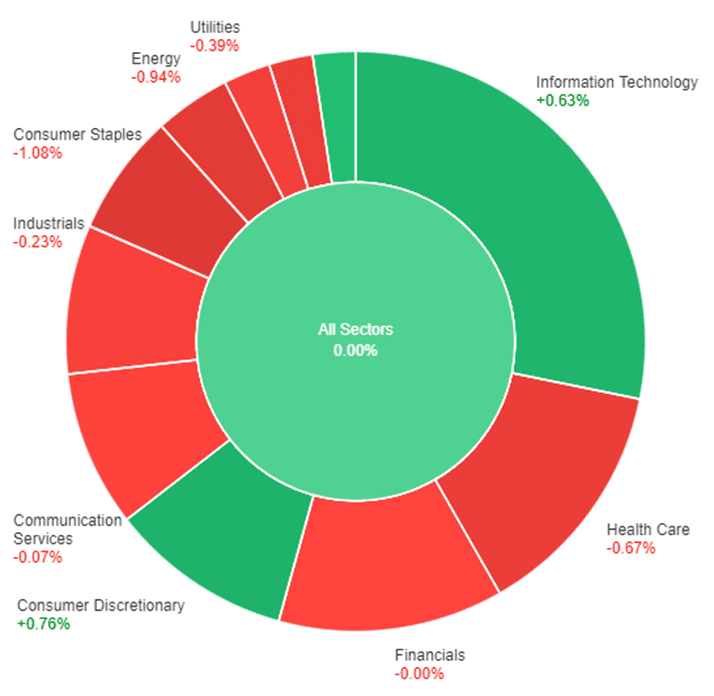
All sectors' performances amidst concerns of a potential raise to the US debt ceiling.

Data by Bloomberg

On Tuesday, the overall market performance was neutral, with all sectors collectively showing no change (+0.00%). Among the sectors that experienced gains, Consumer Discretionary had the highest increase of 0.76%, followed by Information Technology at 0.63%. Real Estate showed a modest increase of 0.27%. On the other hand, several sectors recorded losses. Consumer Staples had the largest decrease of 1.08%, followed by Energy with a decline of 0.94%. Health Care experienced a decrease of 0.67%, while Materials and Utilities both had losses of 0.59% and 0.39% respectively. Communication Services and Industrials also showed declines of 0.07% and 0.23% respectively. Financials remained unchanged at 0.00%.

Major Pair Movement

The EUR/USD currency pair showed signs of recovery from its 10-week lows on Tuesday, although there is a possibility that it may be influenced by the “sell in May and go away” stock market adage if U.S. data continue to outperform and investors continue to reduce their expectations of a Federal Reserve interest rate cut. These rate cut bets had increased during the U.S. regional banking crisis but have been diminishing and could decrease further if the debt limit deal is approved. The Federal Reserve’s cautious stance on rate hikes during the banking crisis and debt ceiling issue has eased, contributing to a 4.5% rebound in the dollar index since early May. However, it remains below the peak reached before the banking crisis.

The EUR/USD’s slight gain on Tuesday, despite a more bearish outlook, may only be a temporary bounce driven by month-end and pre-U.S. payroll book-squaring activities. The currency pair experienced a significant bearish reversal in May and is expected to retrace at least a portion of its recovery from 2022-23. The USD/JPY and EUR/JPY pairs both declined, with the yen gaining strength due to stable Japanese government bond yields compared to falling Treasury and bund yields following the debt ceiling deal. The USD/JPY also fell after reaching six-month highs as yen short positions became cautious following a meeting between the U.S. and Bank of Japan, which hinted at the possibility of FX intervention to support the yen if necessary. This intervention is viewed more seriously due to previous interventions in late 2023 that resulted in yen weakness and inflation surpassing the Bank of Japan’s 2% target. Sterling gained while the AUD/USD pair declined on concerns related to China.

Picks of the Day Analysis

EUR/USD (4 Hours)

EUR/USD Rebounds as USD Weakens, Debt Limit Drama Looms.

The EUR/USD experienced a slight increase, propelling the Euro to its best day in over a week. Despite the Eurozone’s Harmonized Index of Consumer Prices declining more than expected, the US dollar’s decline against European currencies and the yen provided support. However, the positive news for the European Central Bank regarding inflation may have negative implications for the common currency. Meanwhile, the US faces a potential debt default if Congress fails to pass a bill, adding to growing Republican opposition to the deal. Additionally, economic data shows a drop in the US Conference Board Consumer Confidence Index and the unexpected decline of the Dallas Fed Manufacturing Business Index. Important upcoming releases include the Chicago PMI, ADP Employment Report, and Nonfarm Payrolls report.

Chart of EURUSD performance amidst concerns of a potential raise to the US debt ceiling.

Chart EURUSD by TradingView

According to technical analysis, the EUR/USD pair is moving higher on Tuesday, rising above the 1.07 level and attempting to reach the upper band of the Bollinger Bands. It is anticipated that the EUR/USD will continue its upward movement today and strive to surpass the upper band of the Bollinger Bands. The Relative Strength Index (RSI) is currently at 48, indicating that the EUR/USD has returned to a neutral position.

Resistance: 1.0788, 1.0848

Support: 1.0715, 1.0655

XAU/USD (4 Hours)

Gold (XAU/USD) Rebounds as Debt Ceiling Optimism Fades and Market Concerns Mount

Gold prices (XAU/USD) experienced a rebound after hitting a low point for the day, trading near a daily high as optimism in financial markets wavered following news of a debt ceiling agreement to prevent a default in the US. However, sentiment deteriorated after a slow start to the week and concerns about lawmakers from both major parties being reluctant to pass the deal, reigniting fears of a default. Asian and European indexes traded mixed, influencing Wall Street, with the Dow Jones Industrial Average declining around 120 points and the S&P 500 and Nasdaq Composite struggling to maintain stability. Additionally, US CB Consumer Confidence decreased less than expected in May, indicating a somewhat less positive view of current conditions while expectations remained pessimistic.

Chart XAUUSD performance amidst concerns of a potential raise to the US debt ceiling.

Chart XAUUSD by TradingView

According to technical analysis, the XAU/USD is moving higher on Tuesday, reaching the upper band of the Bollinger Bands and touching the resistance level at $1,962. There is a possibility that the XAU/USD will make a slight downward movement and return to the middle of the Bollinger Bands before moving higher again today. Currently, the Relative Strength Index (RSI) stands at 55, indicating that the XAU/USD is in a neutral position but slightly bullish.

Resistance: $1,962, $1,991

Support: $1,934, $1,913

Economic Data

CurrencyDataTime (GMT + 8)Forecast
AUDConsumer Price Index09:306.4%
EURGerman Prelim CPITentative0.2%
CADGross Domestic Product20:30-0.1%
USDJOLTS Job Openings22:009.41M
Back To Top
server

您好 👋

我能帮您什么吗?

立即与我们的团队聊天

在线客服

通过以下方式开始对话...

  • Telegram
    hold 维护中
  • 即将推出...

您好 👋

我能帮您什么吗?

telegram

用手机扫描二维码即可开始与我们聊天,或 点击这里.

没有安装 Telegram 应用或桌面版?请使用 Web Telegram .

QR code